A one-way analysis of variance (ANOVA) is used when you have one categorical independent variable (IV) (with two or more categories) and a normally distributed interval dependent variable (DV) and you wish to test for differences in the means of the dependent variable broken down by the levels of the independent variable.
Thursday, 27 October 2011

ANCOVA ~ Analysis of Covarience
ANCOVA ~ Analysis of Covarience
Analysis of covariance is like ANOVA, except in addition to the categorical predictors you also have continuous predictors as well.
Analysis of covariance (ANCOVA) is a form of analysis of variance that tests the significance of the differences among means of experimental groups after taking into account initial differences among the groups and the correlation of the initial measures and the dependent variable measures. The measure used as a control variable - the pretest or pertinent variable - is called a covariate (Kerlinger, 1986).
Analysis of covariance (ANCOVA) is a form of analysis of variance that tests the significance of the differences among means of experimental groups after taking into account initial differences among the groups and the correlation of the initial measures and the dependent variable measures. The measure used as a control variable - the pretest or pertinent variable - is called a covariate (Kerlinger, 1986).
ANOVA ~ Analysis of Variance
ANOVA ~ Analysis of Variance
Univariate analysis of variance (ANOVA) is a statistical technique to determine, on the basis of one dependent measure, where samples come from populations with equal means. ANOVA is robust to violations of this assumption, however (Lindman, 1974). Univariate analysis of variance employs one dependent measure, whereas multivariate analysis of variance compares samples based on two or more dependent variables (Hair et al., 1995).
t-test
t-test
A t test is a very standard statistical test to compare the means of two groups. The two sample t-test simply tests whether or not two independent populations have different mean values on some measure. The null hypothesis, which is assumed to be true until proven wrong, is that there is really no difference between given two populations. In simple terms, the t-test compares the actual difference between two means in relation to the variation in the data (expressed as the standard deviation of the difference between the means.
Null hypothesis
Null hypothesis
The null hypothesis, H0, is an essential part of any research design, and is always tested, even indirectly. The simplistic definition of the null is as the opposite of the alternative hypothesis, H1, although the principle is a little more complex than that. The null hypothesis is a hypothesis which the researcher tries to disprove, reject or nullify. The 'null' often refers to the common view of something, while the alternative hypothesis is what the researcher really thinks is the cause of a phenomenon. An experimentconclusion always refers to the null, rejecting or accepting H0 rather than H1.
RESEARCH METHDOLGY
RESEARCH METHDOLGY
Research methodology is the systematic study of methods that are, can be, or have been applied within a discipline. It is a way to systematically solve the research problem. Research Methodology comprises of two words, research and methodology. Research is defined as human activity based on intellectual application in the investigation of matter. The primary purpose for applied research is discovering, interpreting, and the development of methods and systems for the advancement of human knowledge on a wide variety of scientific matters of our world and the universe. Research may be defined as a careful investigation or inquiry especially through search of new facts in any branch of knowledge. In short, it comprises defining a refined problem's, formulating hypothesis or suggested solution; collecting, organizing and evaluating data; making deductions and research conclusions; and lastly carefully testing the conclusion to determine whether they fit the hypothesis.
Normal Distribution
Normal Distribution

The normal distribution is pattern for the distribution of a set of data which follows a bell shaped curve. In many natural processes, random variation conforms to a particular probability distribution known as the normal distribution, which is th most commonly observed probability distribution. It is also known as the Gaussian distribution among the scientific community. A normal distribution is described by its mean  and standard deviation
  . The density curve is symmetrical, centered about its mean, with its spread determined by its standard deviation.
and standard deviation . The density curve is symmetrical, centered about its mean, with its spread determined by its standard deviation.The shape of the curve is described as bell-shaped with the graph falling off evenly on either side of the mean. 50% of the distribution lies to the left of the mean and 50% lies to the right of the mean. The spread of a normal distribution is controlled by the standard deviation. The smaller the standard deviation the more concentrated the data. The mean and the median are the same in a normal distribution.
. The smaller the standard deviation the more concentrated the data. The mean and the median are the same in a normal distribution.
The Standard Normal curve, shown above, has mean value 0 and standard deviation 1. If a dataset follows a normal distribution, then about 68% of the observations will fall within of the mean , which in this case is with the interval (-1,1). About 95% of the observations will fall within 2 standard deviations of the mean, which is the interval (-2,2) for the standard normal, and about 99.7% of the observations will fall within 3 standard deviations of the mean, which corresponds to the interval (-3,3) in this case. Although it may appear as if a normal distribution does not include any values beyond a certain interval, the density is actually positive for all values, 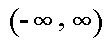 . Data from any normal distribution may be transformed into data following the standard normal distribution by subtracting the mean and dividing by the standard deviation .
of the mean , which in this case is with the interval (-1,1). About 95% of the observations will fall within 2 standard deviations of the mean, which is the interval (-2,2) for the standard normal, and about 99.7% of the observations will fall within 3 standard deviations of the mean, which corresponds to the interval (-3,3) in this case. Although it may appear as if a normal distribution does not include any values beyond a certain interval, the density is actually positive for all values, . Data from any normal distribution may be transformed into data following the standard normal distribution by subtracting the mean and dividing by the standard deviation .- The curve concentrated in the center and decreases on either side. This means that the data has less of a tendency to produce unusually extreme values, compared to some other distributions.
- The bell shaped curve is symmetric. This tells you that he probability of deviations from the mean are comparable in either direction.
Correlation
Simple linear regression
Simple linear regression allows us to look at the linear relationship between one normally distributed interval predictor and one normally distributed interval outcome variable.
Non-parametric correlation
A Spearman correlation is used when one or both of the variables are not assumed to be normally distributed and interval (but are assumed to be ordinal). The values of the variables are converted in ranks and then correlated.
Multiple regression
Multiple regression
Factor analysis
Factor analysis
Factor analysis is a form of exploratory multivariate analysis that is used to either reduce the number of variables in a model or to detect relationships among variables. All variables involved in the factor analysis need to be interval and are assumed to be normally distributed.The goal of the analysis is to try to identify factors which underlie the variables. There may be fewer factors than variables, but there may not be more factors than variables.The main applications of factor analytic techniques are:(1) to reduce the number of variables and(2) to detect structure in the relationships between variables, that is to classify variables.Therefore, factor analysis is applied as a data reduction or structure detection method (the term factor analysis was first introduced by Thurstone, 1931). The topics listed below will describe the principles of factor analysis, and how it can be applied towards these two purposes.
statistics solutions
statistics solutions
I provide statistical solutions for the students, lecturers, professors in completion of their dissertations, Ph.D., projects specially in Education and Psychology.
Ph.D. Education
Current Post: Asst. Professor of Economics
So if you want statistics solutions can contact at anu0562@gmail.com
Subscribe to:
Comments (Atom)